
The New
Money Game


A financial system built for today, designed to restore belief that winning is possible.

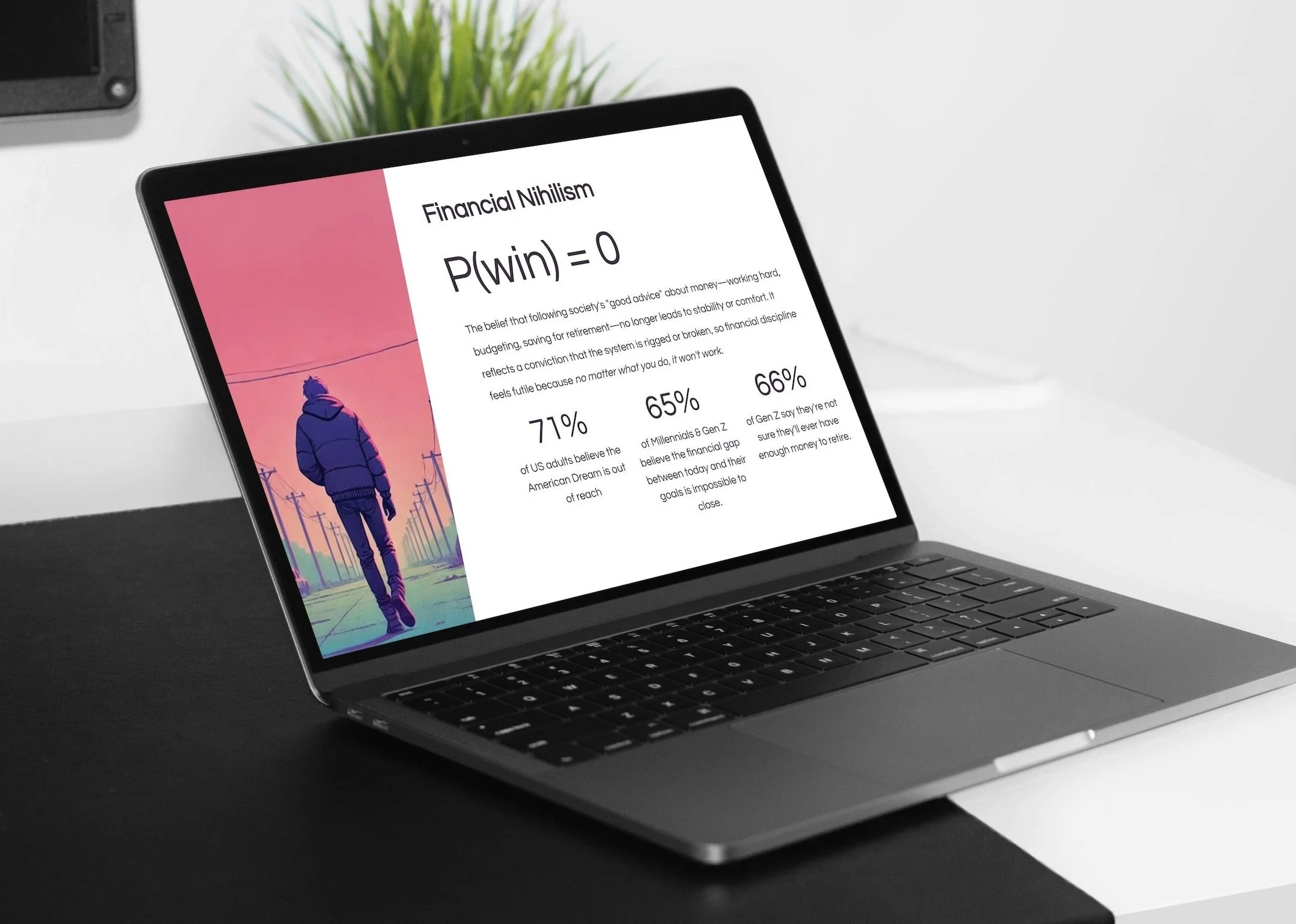
Financial Nihilism: Understanding the Growing Crisis of Economic Despair
A Primer on P(win) = 0

Why an Entire Generation Believes the Financial Game is Rigged
I came across a comment about retirement on Reddit that’s been playing on repeat in my head ever since: "My retirement plan is either total societal collapse or death, so, yeah."
And what’s sad is that comments like this have become common. They come from real people with real reasons to complain. People making what used to be thought of as great salaries, working at great companies, are doing the math and concluding that traditional financial advice is basically financial fan fiction. And the sad truth is that they're not entirely wrong.
Welcome to Financial Nihilism…
-
At 37Maru, we’ve been studying "Financial Nihilism" which is shorthand for the growing belief that following society's "good advice" about money simply doesn't work anymore. It's the conviction that no matter how hard you work, how much you budget, or how diligently you save, the probability of winning the financial game equals zero.
Surveys agree. 71% of U.S. adults now believe the American Dream is out of reach. 65% of Millennials and Gen Z think the financial gap between where they are and where they need to be is impossible to close. 66% of Gen Z aren't sure they'll ever have enough money to retire.
This isn't just pessimism or social media amplifying negative news to chase clicks. It's a rational response to a system that's fundamentally broken.
The Math That Broke the American Dream
So what does it actually cost to achieve the traditional markers of success? Is the negativity due to shifting wants and unrealistic expectations or has the social contract fundamentally changed?
The conclusion is that the problem is real. The lifetime cost of the American Dream has skyrocketed to over $5 million:
$958K for homeownership
$1.6MM for retirement
$876K for raising two children (including college)
$415K for healthcare
$900K for transportation
$180K for vacations
Meanwhile, home prices have risen 48% since 2019 while median income only grew 22%. The national median home price-to-income ratio has hit 5x, which means that a typical house costs five times what a typical family makes in a year. In some markets, childcare costs more than college tuition, eating up 22% of household income when experts say 7% is what would be considered" affordable."
But it doesn’t stop there. Even the “revenue” side of living an intentional and happy life has changed. 41% of recent college graduates are working in jobs that don't even require their degree. And nearly 25% of bachelor's degrees now produce negative returns on investment. So many 20 somethings have found themselves six figures in debt for credentials that in many cases have no real value.
And in every category of life the stories are similar. The “COGS” to buy the basics of life have fundamentally changed. The costs have grown much faster than income has risen for important essentials like healthcare, childcare, transportation and food….and the list goes on and on. Everything has changed.
When the Rules Change, Players Change Their Strategy
So what happens when an entire generation concludes that the traditional playbook is worthless? The answer is obvious:
When a player in a game believes that the probability of winning equals zero no matter what they do, any move becomes rational. When P(win)=0 you do everything you can to change the game.
We're seeing this everywhere:
55% of Gen Z investors are putting money into cryptocurrency instead of traditional investments
0DTE options trading (zero days to expiration...essentially financial gambling) now represents 55-60% of SPX options volume
Buy Now, Pay Later services are exploding and users report it fuels their desires for immediate gratification (why save for a future that feels impossible?)
Americans have consistently voted for "change" candidates, rejecting the status quo in every election since 2008
It's not irresponsibility. It's a natural response to a system that no longer delivers on its promises.
Rebuilding Belief that P(Win) can equal 1
Rebuilding faith in a system that’s fundamentally broken is no easy task. It will likely require a new financial framework that accounts for today's realities instead of yesterday's assumptions. It will require much more guidance and intentionality if consumers want to navigate today’s world without daily financial stress and crushing anxiety about retirement. And it will require success stories to hold up as examples and a movement of believers to dispel the growing spread of doomerism and nihilism in the world.
To be clear, some problems are so large that they’ll require government and industry solutions to fix over time. A tech company isn’t going to “app” its way out of society’s crushing systematic cost inflation of essential services.
But here's what technology and intelligent financial product design CAN do: It can build systems and products that help people believe they can actually win. And the wins won’t be tied to get-rich-quick schemes or financial gambling, but they’ll come due to frameworks and products that translate individual values and circumstances into meaningful, personalized strategies and solutions.
The Real Opportunity
We've just started to build exactly this kind of company. It aims to massively increase people's belief that they can succeed financially by creating new approaches that work within current realities. We won’t pretend the system isn't broken, but we will create a winnable playbook.
Our view is that financial nihilism isn't a character flaw, but rather a rational response to irrational circumstances. We refuse to accept is that it’s permanent and an unsolvable problem.
So, if you're interested in this problem space, if you have ideas about solutions, or if you're working on changing how people think about money, we want to hear from you. If you stare at it long enough you might come to the same conclusion that we have: The biggest financial crisis society is facing is in people's belief that they can’t build a better future.
And that's a problem worth solving.
Want to discuss this further? We’re interested in assembling a cross-discipline ride-or-die team to create solutions that will help people increase the odds of navigating today’s expensive world. Reach out. We’d love to figure this out together.

Early Team Roles
We’re at the very beginning — just the two of us — and we’re in the early stages of exploring what our early team could look like. Think of this as an open call for early collaborators, not a conventional hiring process. AI is embedded in how we work, and we’re looking for people who thrive in ambiguity, move fast, and take deep ownership across disciplines when the business needs it. If you have skills in Engineering, Product, Content, Data, or Partnerships, tell us about yourself. We’re meeting builders now, and shaping roles for our remote first company (US & Canada) over the coming months.